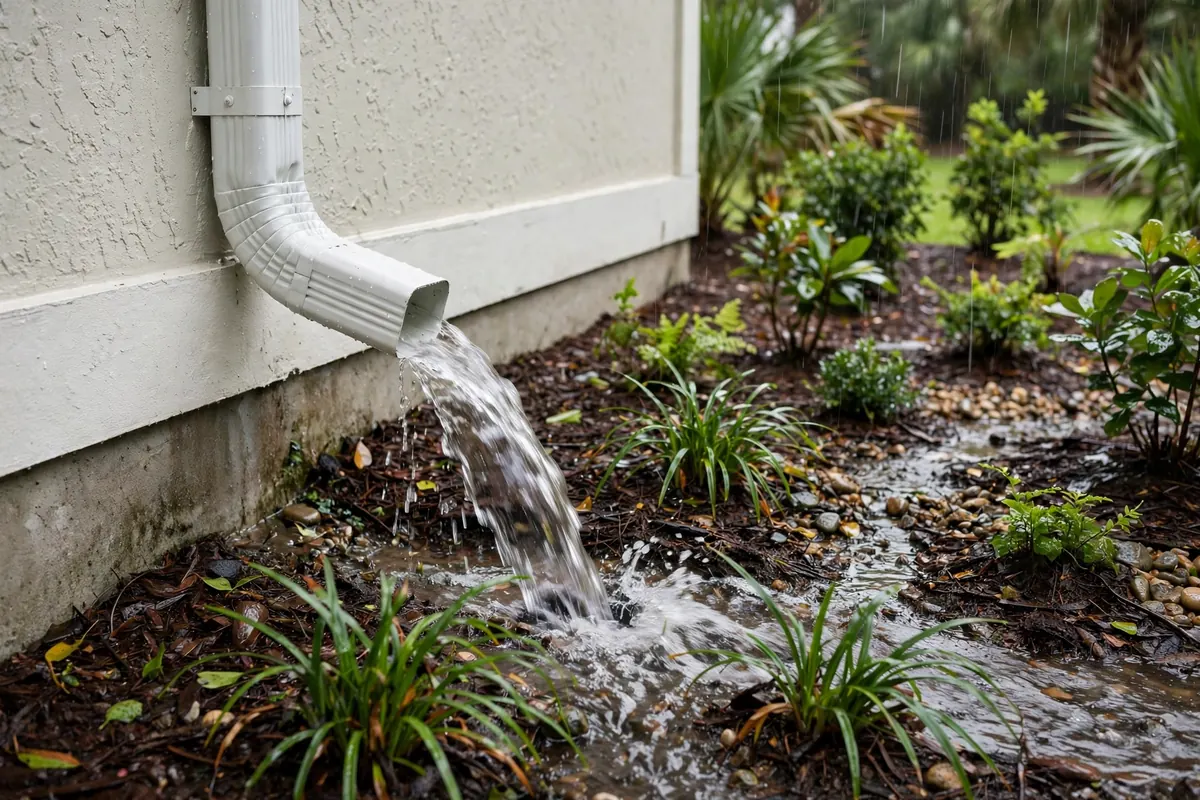
Gutter Services · Fort Pierce, FL
Downspout Installation, Fort Pierce, FL
Our downspout installation in Fort Pierce pairs oversized 3×4-inch downspouts with extensions and grading-aware placement — because in Florida, where the water goes matters as much as catching it.
- Oversized 3×4-inch downspouts — double the roof area per drop
- Extensions and splash blocks that clear your foundation
- Underground drainage options for problem lots
Follow the Water: Roof to Safe Discharge
A gutter system is only as good as its exit strategy. Here is the complete journey every drop should take on your Fort Pierce home:
Gutters are only half the system
Gutters Are Only Half the System
Here’s a sentence that costs Fort Pierce homeowners thousands: “The gutters are new, so the drainage must be fine.” Gutters catch water; downspouts decide where it goes — and downspout installation in Fort Pierce is where most systems quietly fail. Undersized 2×3-inch drops on a 6-inch gutter. Downspouts discharging eighteen inches from the slab. Elbows clogged with the palm frond nobody flushed. As part of our Fort Pierce gutter services, we treat downspouts as engineered drainage, not accessories: sized to the roof, placed for the grading, and extended past the foundation. Downspout installation Fort Pierce homes need isn’t an afterthought — it’s the half of the system that actually moves water away from your slab. For Downspout Installation Fort Pierce, our crew handles everything from inspection to final cleanup.
The math is unforgiving. A standard 2×3-inch downspout drains roughly 600 square feet of roof; an oversized 3×4-inch downspout drains roughly 1,200. Put the small ones on a big Florida roof and the gutters can be perfect — the water still has nowhere to go, so it goes over the front edge and lands at your slab. Around 54 inches of annual rain, most of it in cloudbursts, punishes that bottleneck every single storm. Every downspout installation project we do in Fort Pierce starts by mapping where water goes today, then we design the route — ideally paired with seamless gutter installation for a complete system. Downspout Installation Fort Pierce is one of our most requested services across the Treasure Coast.
Then there’s placement. In our sandy soil, water dumped at the foundation doesn’t politely soak away — it pools, erodes, and seeps. Every downspout should discharge at least 4 feet from your foundation, and on problem lots — the known flood pockets like Virginia Avenue and Oleander, White City Park, and Sabal Chase — even that isn’t always enough without extensions or buried drainage. When you need Downspout Installation Fort Pierce, call (772) 262-4370 and we'll set up a visit.
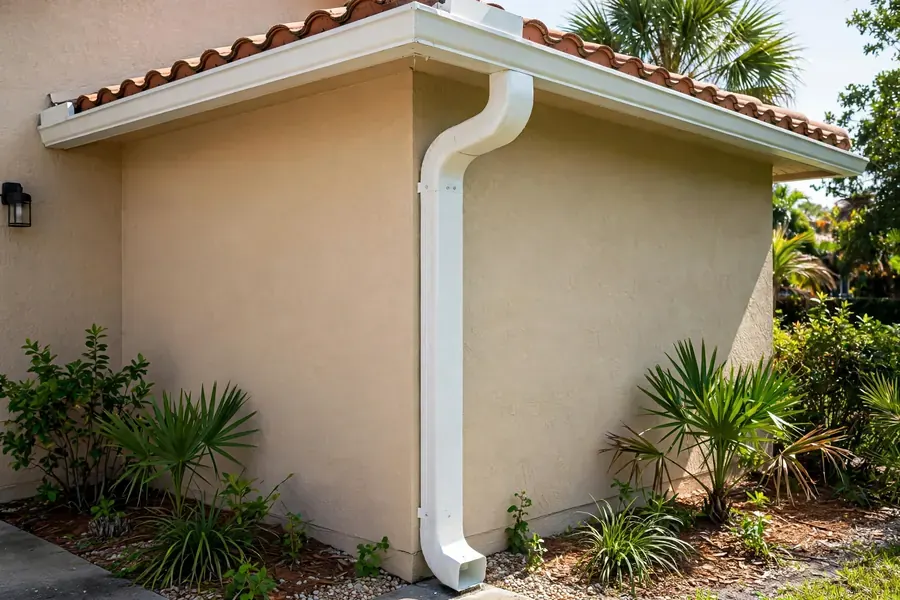
Downspout Installation, Fort Pierce: Sizing It Right
We install 3×4-inch downspouts as standard — each one drains roughly 1,200 square feet of roof, double the roughly 600 square feet a standard 2×3-inch downspout can handle. That’s why downspout installation across Fort Pierce should always include extensions or buried drains — dumping at the foundation defeats the purpose. Here's what Downspout Installation Fort Pierce looks like done right: clean lines, secure hangers, and water draining away from the foundation.
That doubling matters because downspouts are the choke point of the whole system. A 6-inch gutter feeding 2×3 downspouts is like a six-lane highway merging into two — the trough fills from the bottom up during a cloudburst and overflows at the top. Match the 6-inch gutter with 3×4 drops and the whole system breathes: water in, water out, no drama. Every Downspout Installation Fort Pierce project gets the same careful, tidy workmanship.
On new installations we size drops from the roof plan — square footage per drainage zone, valley concentrations, and the long runs where water arrives fastest. On existing systems, adding or upsizing downspouts is often the single highest-value upgrade: it’s a fraction of a gutter replacement’s cost and it fixes the overflow the gutters get blamed for. That’s exactly what we do — call (772) 262-4370.
How Many Downspouts Does a Florida Home Need?
Enough that no single drop is asked to drain more roof than it can swallow in a cloudburst — typically one per major roof section, with extras on long runs and under heavy valley concentrations. From inspection to final cleanup, our crew handles the whole job.
The rule we work from: every distinct roof plane gets its own drainage, and long straight runs get drops at both ends rather than one lonely downspout in the middle. Valleys — where two roof planes funnel water into one spot — concentrate enormous flow and almost always deserve their own oversized drop. That’s the detail missing on most builder-grade installations, and it’s why so many Fort Pierce homes overflow at exactly one corner. It’s one of our most requested services across the Treasure Coast.
More downspouts also mean redundancy. When one elbow clogs with palm debris mid-season — and eventually one will — the neighboring drops pick up the slack instead of the whole run overtopping. In a climate where a clogged drop can dump hundreds of gallons at your slab in an hour, redundancy isn’t luxury; it’s insurance. When you need us, call (772) 262-4370 and we’ll set up a visit.
Getting Water Away From Your Slab
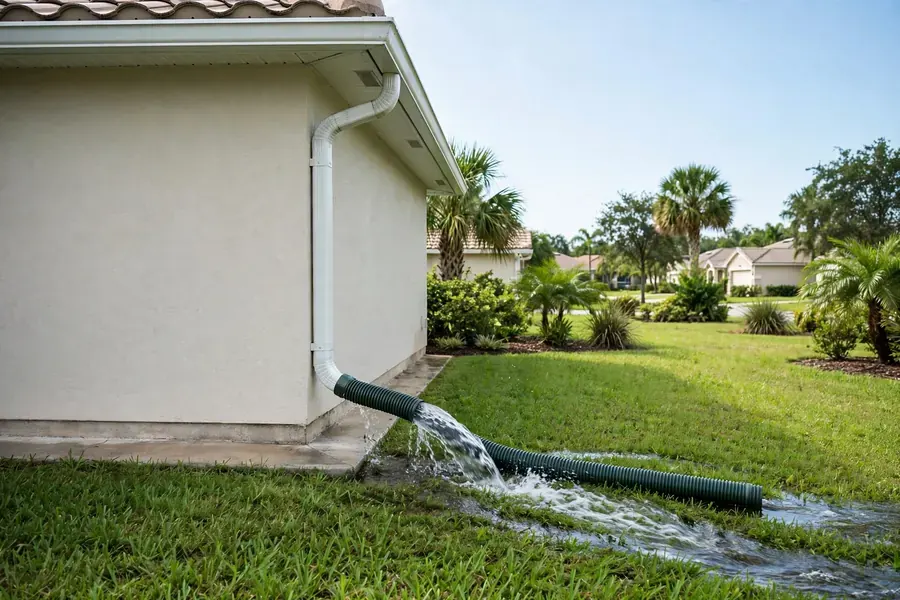
Every downspout should discharge at least 4 feet from your foundation — in our sandy soil, water dumped at the slab pools fast, erodes landscaping, and seeps toward the foundation. Here’s what the job looks like done right: clean lines, secure hangers, and water draining away from the foundation.
The classic failure: a downspout that ends eighteen inches from the house, dumping a waterfall into the mulch bed every storm. The mulch washes out, the soil erodes into a little canyon, and water ponds against the slab — exactly where you don’t want it during the May-to-October rainy season. Extensions and splash blocks are the simple fix, hinged or removable where mowing and foot traffic demand it. Every project gets the same careful, tidy workmanship.
On lots with real grading problems — and in the known flood pockets like Virginia Avenue and Oleander, White City Park, Orange Blossom Estates, and Sabal Chase, where street flooding is already a fact of life — extensions alone may not cut it. That’s when we talk about buried drainage: solid pipe carrying roof water well past the problem area to daylight. That’s our specialty — call (772) 262-4370.
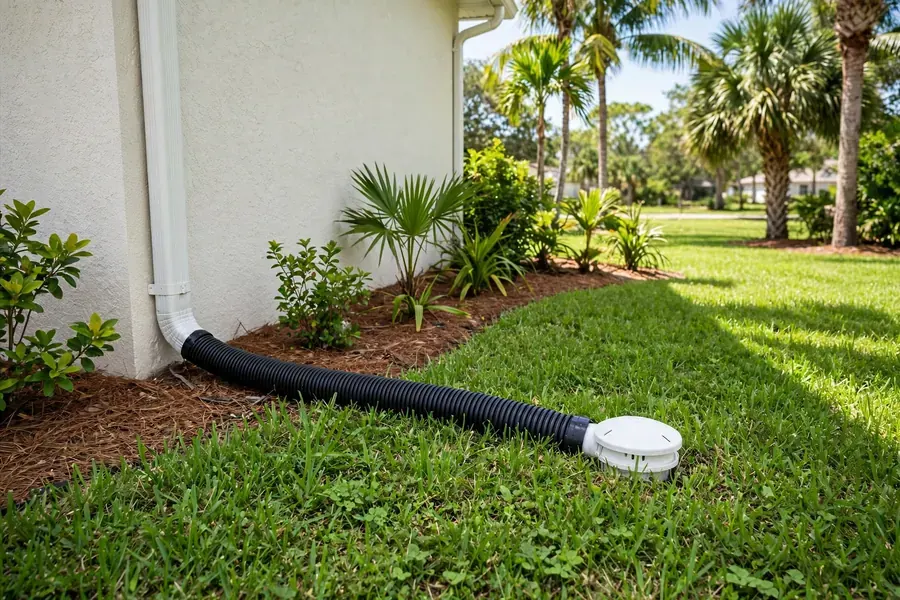
Underground Drainage and Extensions
When grading won’t cooperate, we run downspouts into buried solid-pipe drainage that daylights well away from the house — with cleanouts so the system stays serviceable. Our crew takes care of everything, from the first look to the final cleanup.
Buried drainage is the clean solution for downspouts that would otherwise cross walkways, patios, or low spots that never dry. We use solid PVC — never perforated pipe for roof water, which just re-releases it underground near the house — bedded properly, sloped to drain, and terminated at a pop-up emitter or daylight outlet well clear of the foundation and the neighbor’s lot. This is one of the jobs Treasure Coast homeowners ask us for most.
Every buried run gets cleanouts at the top, because underground pipe and Florida oak debris are a eventual clog waiting to happen — the difference between a five-minute flush and a dug-up yard is planning. We map every run for you, so future landscaping or fence work doesn’t discover the pipe the hard way. Ready when you are — call (772) 262-4370 to schedule a visit.
Keep exploring
Related Gutter Services in Fort Pierce
Downspouts are part of a complete drainage system. These are the services Fort Pierce homeowners pair with downspout work: Done right, here’s what you get: clean lines, secure hangers, and water draining away from the foundation.
Seamless Gutter Installation
Downspouts only work if the gutters feeding them are sized right — 6-inch seamless troughs with screwed hangers, formed on-site. Every job gets careful, tidy workmanship from start to finish.
Learn moreGutter Guards
The number-one killer of downspouts is debris washing in from above. Micro-mesh guards keep elbows and outlets clear. That’s what we’re here for — call (772) 262-4370.
Learn moreGutter Repair
Detached, crushed, or leaking downspouts? Most downspout damage is a quick repair — reattached, resealed, and re-pitched.
Learn moreCatch the Water. Then Send It Packing.
If your downspouts dump water at your foundation, overflow in every storm, or your gutters were installed without a drainage plan — call Fort Pierce Gutter Pros. We’ll size, place, and extend your downspouts so water ends up far from your slab. Every downspout installation project in Fort Pierce is designed by the gutter installation Fort Pierce crew — water carried well clear, guaranteed.
Prefer to talk it through? (772) 262-4370
Research
The Sizing Rules Most Installers Get Wrong
Here's what most homeowners never hear: the downspout matters as much as the trough. You can hang the biggest, best-pitched system on the market, and a choked outlet will still send water cascading over the edge during a Fort Pierce downpour. The industry rules for getting this right come from the pros at This Old House — and they're simple enough to check on your own home.
Norm Abram's rule: you need roughly one square inch of downspout cross-section for every 100 square feet of roof area. A standard 2×3-inch rectangular outlet gives you 6 square inches — enough for about 600 square feet of roof. A 3×4-inch gives you 12 square inches, covering roughly 1,200. On a typical Fort Pierce ranch with 1,500+ square feet of roof feeding one side, a single 2×3 outlet is undersized before the first cloud forms. As Holda Construction warns: "Treat gutters as plumbing for rain — catch window + pitch + outlets + downspouts + clean transitions. If any link is undersized or poorly executed, overflow shows up at the ground."
Tom Silva's rule: any run 60 feet or longer gets at least two outlets. One outlet on a long run means water has to travel the full length to escape — and during peak intensity, it never makes it. The far end overflows while the near end sits half-empty. If your home has a long, unbroken eave with a single outlet in the middle, that's a design flaw, not a maintenance issue.
The 5-Foot Rule (and When It's 10)
Where the water lands matters as much as how fast it gets there. Every outlet should discharge at least 5 feet from the foundation — 10 feet if your yard is flat. Fort Pierce's sandy soil shifts and erodes easily; water dumped at the foundation line carves channels, undermines grading, and feeds the high water table that's already pressing against your slab. Regrade the soil to slope away from the house — six inches of fall over the first ten feet is the target. And watch your neighbors: in many Fort Pierce neighborhoods, adjacent properties share drainage patterns, and a neighbor who regrades their yard can redirect thousands of gallons toward your foundation.
| Roof Area per Outlet | Downspout Size | Cross-Section |
|---|---|---|
| Up to 600 sq ft | 2×3" rectangular | 6 sq in |
| 600–1,200 sq ft | 3×4" rectangular | 12 sq in |
| 1,200–2,000 sq ft | Two 3×4" or one 4×5" | 20–24 sq in |
| Steep or metal roof | Size up one level | Faster runoff needs more capacity |
For underground drainage — the buried pipe that carries water away from the house — keep it simple: solid PVC, proper slope, and a cleanout where you can reach it. If your buried line clogs, the whole system backs up to the outlet, and you'll see overflow at the elbow during the next storm. When we install or replace outlets in Fort Pierce, we size them to Norm Abram's rule, extend them to the 5-foot minimum, and make sure the underground run can actually carry what the roof delivers. Call (772) 262-4370 for an assessment.
New Build on a Flat Lot? Start With the Discharge Plan
On a flat, sandy lot, the downspout matters more than the trough — the water has nowhere to fall on its own. Extensions and splash blocks handle most lots; where the grade won’t cooperate, we run buried solid pipe to a pop-up emitter or daylight outlet well clear of the slab and the neighbor’s lot.
One thing to check before the work starts: new work near a property line may need a drainage plan by a design professional under the City’s stormwater rules — gutters and downspouts aren’t required to fulfil it, and a gable end with downhill slope is one place a gutter makes no sense. We can talk through what your address needs before we quote.
Common questions
Fort Pierce Gutter FAQs
Capacity. A standard 2×3-inch downspout drains roughly 600 square feet of roof; an oversized 3×4-inch downspout drains roughly 1,200 — double. On Florida roofs with our cloudburst rainfall, 3×4 is our standard because it keeps the whole system from bottlenecking at the drops. Most downspout installation jobs in Fort Pierce add a half-day to a gutter project, or a standalone day for retrofits.
At least 4 feet from your foundation — that’s our minimum. In our sandy soil, water dumped closer pools against the slab, erodes landscaping, and seeps toward the foundation. Extensions, splash blocks, or buried drainage get it there.
Yes — adding or upsizing downspouts is one of the highest-value upgrades we do. If your gutters are sound but overflowing, the bottleneck is often at the drops, and new 3×4-inch downspouts cost a fraction of a full replacement.
Yes. We run downspouts into buried solid PVC — never perforated pipe for roof water — sloped to daylight or a pop-up emitter well clear of the foundation, with cleanouts at the top so the run stays serviceable.
Yes — detached downspouts are a quick repair. We reattach with proper straps and fasteners, check the elbows for cracks, and make sure it’s discharging away from the slab, not just hanging back on the wall.
Yes, and they will — we stock 20+ factory colors and match downspouts, elbows, and extensions to your gutters and trim, including HOA-required palettes in the 55+ and gated communities.
Splash blocks are the concrete or plastic trays under the downspout outlet that spread water and slow erosion — good for a few feet. Extensions are pipe sections that carry water farther — hinged or removable where mowing demands it. For real distance, buried drainage beats both.
If the bottleneck is at the drops, yes — and it often is. But if your troughs are undersized 5-inch gutters overflowing in ordinary rain, bigger downspouts help without solving it. We’ll diagnose honestly before quoting either.
Usually not on their own. On a flat, sandy lot, water dumped at the slab pools fast and erodes the soil at the drip line — the downspout has to discharge at least 4 feet from the foundation, and on the flattest lots that means extensions, splash blocks, or buried pipe to a pop-up emitter. We look at the grade first and size the discharge to the lot, not just the roof.