Gutter Services · Fort Pierce, FL
Gutter Guards, Fort Pierce, FL
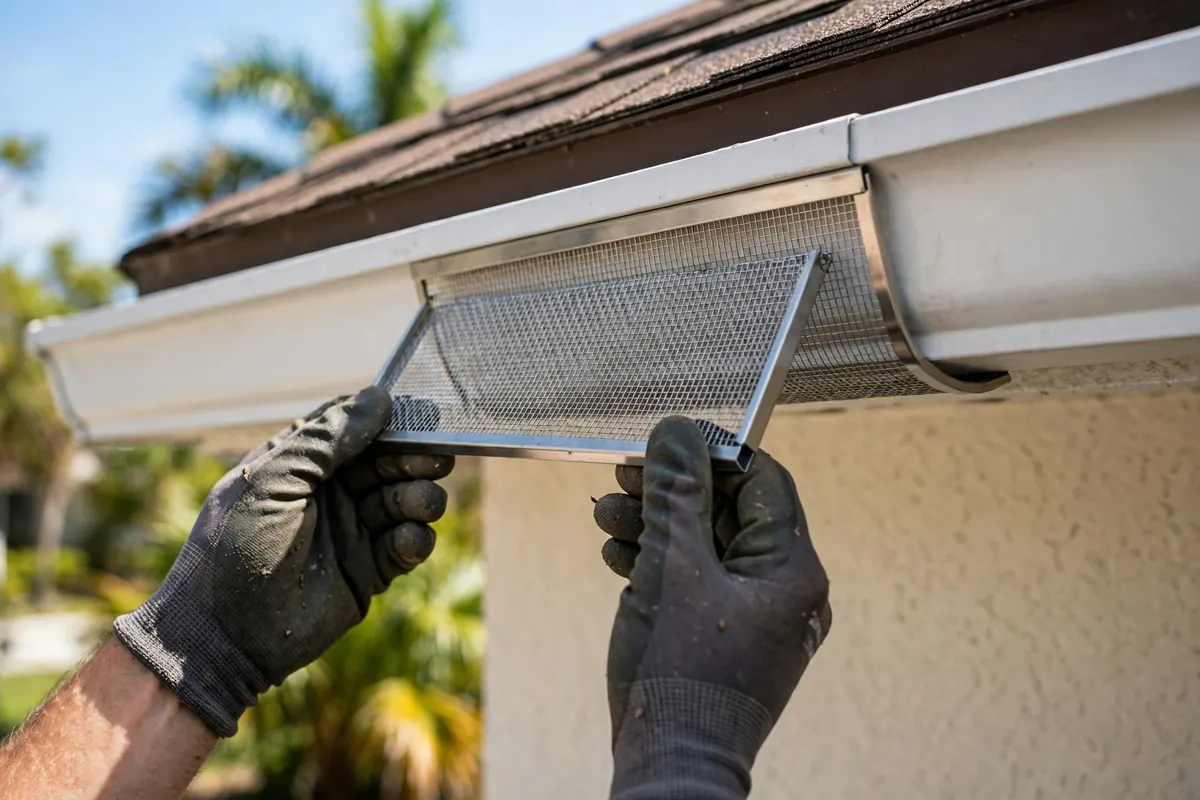
Our gutter guards in Fort Pierce are stainless micro-mesh systems built for Florida debris — oak leaves, pine needles, palm fronds, and pollen — without choking off downpour flow.
- Micro-mesh blocks leaves, needles, fronds, and pollen
- Stainless steel mesh options for salt-air streets
- Sized to your gutters first — guards never fix undersized troughs
Florida debris needs more
Florida Debris Needs More Than a Screen
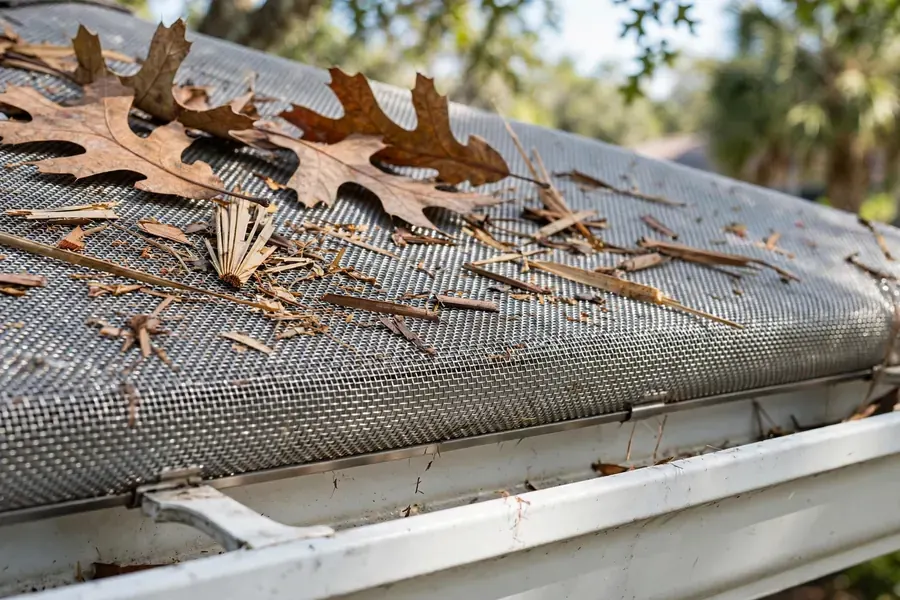
Live oaks, sabal palms, and pines don’t shed on a schedule — they drop leaves, tassels, needles, fronds, and pollen year-round, which is why gutter guards in Fort Pierce have to handle a debris mix most of the country never sees. The right guard keeps all of it out of your troughs while letting a two-inches-an-hour downpour through. The wrong guard — foam, brush, or a cheap screen — clogs, holds moisture, or turns your gutters into a waterfall. As part of our Fort Pierce gutter services, we install only micro-mesh systems we’d put on our own homes. The right gutter guards Fort Pierce homes need must handle live-oak tassels, palm fronds, and pine needles — not just northern maple leaves. For Gutter Guards Fort Pierce, our crew handles everything from inspection to final cleanup.
Here’s the question every homeowner asks, and the honest answer: good guards work, but no guard eliminates maintenance forever. What micro-mesh does is change gutter cleaning from a three-or-four-times-a-year chore into an annual inspection — the mesh keeps debris on top where wind and rain clear most of it, instead of inside the trough where it composts into a dam. Every gutter guard installation we do in Fort Pierce starts with a full cleanout, and we’ll match you to the right gutter guard types for your trees. Gutter Guards Fort Pierce is one of our most requested services across the Treasure Coast.
The second honest point: guards are only as good as the gutters underneath them. Put a guard on an undersized 5-inch trough and heavy rain can sheet right over the top — the issue is usually the gutter size, not the guard. We size first, then guard, which is why we’ll talk gutters before we talk guards. When you need Gutter Guards Fort Pierce, call (772) 262-4370 and we'll set up a visit.
Gutter Guards, Fort Pierce: What Actually Works
We install stainless steel micro-mesh only — it blocks oak leaves, pine needles, palm fronds, and pollen while letting heavy rain pass straight through. Foam and brush inserts trap moisture in Florida humidity, so we don’t install them, full stop. Done right, you get clean lines, secure hangers, and water draining away from the foundation.
Not sure which guard type fits your roof and trees? See our gutter guard types guide for an honest comparison of micro-mesh, screens, reverse-curve, and foam — what survives Florida debris and what doesn’t. Then call (772) 262-4370 and we’ll match the right system to your home.
Size First, Then Guard
If your gutters are undersized 5-inch troughs, adding guards can make overflow worse in heavy rain — the issue is usually the gutter size, not the guard, so we fix sizing before we install guards. From inspection to final cleanup, our crew handles the whole job.
Here’s the physics: a guard slightly reduces the open area at the top of the gutter. On a properly sized 6-inch trough, that’s irrelevant — there’s capacity to spare. On a marginal 5-inch trough that was already struggling with Florida cloudbursts, the guard becomes the scapegoat for what was really a sizing problem all along. It’s one of our most requested services across the Treasure Coast.
That’s why our guard estimates start with your gutters, not our product. If your troughs are sound and properly sized, we fit guards to them. If they’re undersized or failing, we’ll tell you that guards alone won’t solve your overflow — and quote the gutter upgrade honestly alongside the guard price. When you need us, call (772) 262-4370 and we’ll set up a visit.
Coastal Homes Need Corrosion-Resistant Mesh
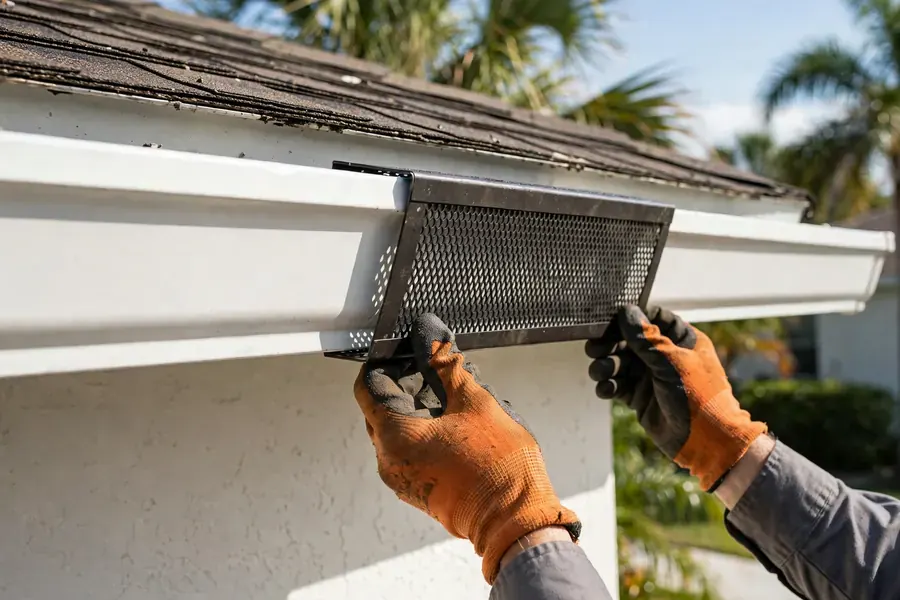
On Hutchinson Island and the beaches, we fit stainless steel mesh — plain screens corrode in salt air and sag into the trough. Inland, quality powder-coated micro-mesh performs beautifully. We match the guard material to your street. For the full breakdown of which material suits which home, see our guard types guide — or call (772) 262-4370 and we’ll recommend the right one for your address.
Simple from start to finish
How Guard Installation Works
From your first call to the final walkthrough, here’s exactly what happens — no surprises, no pressure.
1. Inspection
We walk your roofline, check gutter size and pitch, look at fascia condition, and note your trees and debris load. If your gutters are undersized or failing, we’ll tell you straight — guards alone won’t fix that.
2. Recommendation
You get a written quote naming the guard material, linear footage, and price — plus an honest answer on whether your current gutters are worth guarding or need attention first.
3. Installation Day
We clean out your gutters first, then fit the micro-mesh panels — most homes are done in a few hours. We check pitch and flow as we go so water drains properly from day one.
4. Cleanup & Walkthrough
We haul away all debris, rinse the work area, and walk the roofline with you so you can see the finished job before we leave. Then you’re done climbing ladders.
What Guards Won’t Do: Our Honest List
Guards won’t eliminate maintenance entirely — plan on an annual inspection, because fine roof grit and pollen film still wash through the mesh and settle in the trough over time. Our crew takes care of everything, from the first look to the final cleanup.
Here’s the full honest list. Guards won’t fix undersized gutters, bad pitch, or rotted fascia — those are gutter problems, not debris problems. They won’t stop every pine needle in a windstorm; a few will always find a way in. And screened covers that hold standing water can become mosquito breeding chambers in our climate, which is why we pitch every installation for drainage and check flow during the annual inspection. This is one of the jobs Treasure Coast homeowners ask us for most.
Anyone who tells you “never clean your gutters again” is selling, not advising. What we promise instead: dramatically less cleaning, no more seasonal ladder climbs through the oak tassels, and gutters that actually drain when the sky opens up. Ready when you are — call (772) 262-4370 to schedule a visit.
The Real Debate: Do They Actually Work?
This is the question every homeowner asks, and the honest answer is: it depends on the type. Independent installer field data shows a clear split. Stainless micro-mesh systems consistently outperform every other design in real-world conditions. Reverse-curve covers, on the other hand, have a documented failure mode that matters enormously in Florida.
Here's what the field data actually says. Micro-mesh uses a fine stainless steel screen that blocks pine needles, oak tassels, pollen, and palm debris while letting water through. Its failure modes are maintenance headaches, not functional breakdowns — pollen film that self-clears with the next rain, or aluminum-mesh corrosion from pine sap (solved by choosing stainless mesh). As one independent field review put it: “Micro-mesh's failure modes are minor maintenance headaches. Reverse-curve's failure modes are catastrophic functional failures that leave homeowners worse off than if they'd installed nothing at all.” — Furilia field review.
Reverse-curve systems work on surface tension — water clings to a curved nose and flows into the trough while debris falls off the edge. In gentle, steady rain (under 0.75 inches per hour peak intensity), they perform well. But Florida's tropical downpours routinely exceed that threshold. At high rainfall intensity, water overshoots the curve instead of clinging to it. Homeowners in Texas, the Pacific Northwest, and the Southeast report regular overflow during seasonal storms. Independent testing confirms micro-mesh systems outperform reverse-curve designs when properly installed — KnowledgeMentors field review.
The maintenance question deserves honesty too. Quality micro-mesh reduces cleaning from quarterly to annual or biennial — but it does not eliminate maintenance entirely. As Pacific Northwest installer Aaron's Elite Gutters puts it, stopped debris has to go somewhere — and that somewhere is sitting on top of the mesh instead of inside the trough. Debris still accumulates on top of the mesh, particularly under heavy oak canopy or palm trees. Plan on an annual rinse and brush-off. That's still a massive improvement over quarterly ladder climbs, but anyone promising “never clean again” is selling, not advising.
For Fort Pierce specifically, three things matter. First, our downpours are intense — a single tropical rain band can drop three to five inches on your roof in an hour. That rules out reverse-curve for most homes here. Second, our debris is mixed: oak leaves (large and flat), pine needles (thin and sharp), palm fronds (heavy), and Spanish moss (drapes and mats). Only micro-mesh handles all four. Third, salt air corrodes cheap aluminum-mesh or plastic-frame systems fast — stainless mesh with an aluminum frame is the only combination that holds up on the Treasure Coast.
| Maintenance Task | Without Protection | With Quality Micro-Mesh |
|---|---|---|
| Trough cleaning | Quarterly (4×/year under oaks) | Annual rinse and inspection |
| Pine needle removal | Spears through screens; hand-pick each time | Blocked at the surface; brush off yearly |
| Downpour overflow risk | Clogged outlets cause spillover | Outlets stay clear; water flows freely |
| Mosquito breeding | Standing water in clogged troughs | Properly pitched mesh drains; no standing water |
| Ladder climbs per year | 4–6 | 1–2 |
The bottom line: the debate isn't really about whether protection works — it's about which type you choose. Stainless micro-mesh installed by a crew that pitches for drainage is the honest answer for Fort Pierce homes. Everything else is a compromise you'll feel during the first August downpour. Call (772) 262-4370 and we'll give you a straight assessment of what your roof actually needs.
Keep exploring
Related Gutter Services in Fort Pierce
Guards work best as part of a complete system. Start here to go deeper on guards: Done right, here’s what you get: clean lines, secure hangers, and water draining away from the foundation.
Gutter Guard Types
Micro-mesh vs. screens vs. reverse-curve vs. foam — an honest comparison of what survives Florida debris and hurricane-volume rain. Every job gets careful, tidy workmanship from start to finish.
Learn moreGutter Guard Cost
Treasure Coast market ranges per linear foot, what drives the price up or down, and when guards pay for themselves.
Learn moreStorm-Season Gutter Maintenance
Hurricane-season prep for your roofline: the pre-storm checklist, and why guarded gutters ride out tropical systems better.
Learn moreClimb the Ladder Less. We’ll Handle the Rest.
If you’re cleaning gutters three or four times a year — or watching water pour over clogged troughs every storm — call Fort Pierce Gutter Pros. We’ll size your gutters, fit the right micro-mesh guards, and give you your weekends back. Every gutter guard installation in Fort Pierce is backed by the same crew behind gutter installation Fort Pierce — sized right, fitted right.
Prefer to talk it through? (772) 262-4370
Guards When You’re Away: Fewer Emergency Clogs, Not Zero Maintenance
For an owner who is away, guards are worth it for one reason: fewer emergency clogs mid-season. A guard keeps the big debris out, so a trough that would have packed solid by August stays draining — but it doesn’t eliminate maintenance.
Fine debris, pollen, and grit still get through or mat on the surface, so plan on a seasonal rinse and check while you’re away — we send dated photos of the trough and the flow, so you know it’s draining. And guards go on a sound system: on a sagging run or rotted fascia, fix the gutter first, or the guard just locks the problem in.
Common questions
Fort Pierce Gutter FAQs
Good ones do — micro-mesh guards are the best option for Florida’s mix of oak leaves, pine needles, palm fronds, and pollen. But guards reduce cleaning, they don’t eliminate it. And if your gutters are undersized 5-inch, adding guards can make overflow worse in heavy rain — the issue is usually the gutter size, not the guard. We size first, then guard. Most gutter guard installations in Fort Pierce take a few hours, fitted to your existing gutters or a new system.
No — and be wary of anyone who promises that. Fine roof grit and pollen film still wash through the mesh and settle over time. What micro-mesh does is turn a three-or-four-times-a-year cleaning chore into an annual inspection.
Yes, if your gutters are sound and properly sized. We inspect first — if the troughs are undersized, sagging, or failing, we’ll tell you honestly that guards alone won’t fix the problem.
As a Treasure Coast market range, micro-mesh guards run about $4–$8 per linear foot on top of the gutter cost. The best value is adding them during a new installation or replacement — one crew, one visit. We provide written estimates — no obligation.
They’re worth it most under live oaks. Mature oaks — like the ones shading Indian River Estates and Lawnwood — shed leaves, tassels, and pollen nearly year-round. Without guards you’re cleaning constantly; with micro-mesh, debris stays on top where wind clears most of it.
Only when the gutters underneath are undersized. On properly sized 6-inch troughs, quality micro-mesh passes our downpours without issue. If someone’s guards are causing overflow, the gutters were almost certainly too small to begin with.
Cheap screened covers that hold standing water can become mosquito breeding chambers in our climate. We pitch every guard installation for drainage so water passes through instead of sitting — and we check flow during annual inspections.
Stainless steel micro-mesh. On Hutchinson Island and the beaches, plain screens corrode in the salt air and sag into the trough. Stainless mesh holds up and pairs with aluminum or copper systems.
Yes — a seasonal rinse and check, not a full cleanout. Guards keep the big debris out, but fine debris, pollen, and grit still get through or mat on the surface, and a solid guard can hide standing water underneath. We rinse the surface, check the flow, and send dated photos — so you know it’s draining while you’re away.